- Grid constraints & flexible connections
- Regulation & Policy
Germany has 573 GW of battery grid-connection requests waiting in line, according to Bundesnetzagentur data. Grid operators cannot expand their networks fast enough to connect all of it on firm terms. So, they offer a trade: earlier connection in exchange for limits on how your battery operates.
That trade is the Flexible Connection Agreement (FCA). A few years ago, it was an exception. Today, FCAs are the standard route to connection across Germany, increasingly standardized across DSOs, and in some regions already converging toward shared templates.
If you own, finance, or develop battery storage in Germany, you will likely deal with an FCA. This article covers how different types of FCAs look like and where each restriction type sits in the revenue stack.
Not all FCAs are the same: what's inside the agreement is what matters
Most FCA discussions still start with a yes-or-no decision. Accept the agreement and connect sooner or hold out for firm access and wait.
Whether you sign is rarely the real question. In most cases, an FCA is the only realistic path to connection. What matters is what is inside it. Two contracts can both be called an FCA and still contain very different restrictions, each with a different cost to your battery:
- Import and export restrictions: A cap on maximum charging (import) and/or discharging (export) power at the connection point, potentially tied to live renewables output.
- Ramp rate restrictions: A limit on how fast power output can change, expressed as a percentage of installed capacity per minute.
- Ancillary service restrictions: A limit on how much of your battery you can offer in balancing markets such as FCR and aFRR, where batteries are paid to keep the grid stable.
- Schedule freeze restrictions: A requirement to lock the dispatch schedule a set time before delivery, limiting last-minute repositioning.
- Combined restrictions: Several restrictions layered into one agreement.
Two FCAs can look similar on paper and still cost your battery very different amounts. Restriction type and severity both determine the actual revenue impact.
How to assess the relative revenue impact per restriction type
We analyzed the most common restriction types against an unrestricted baseline, using realized German market data from January 2025 to July 2026 in the TenneT area. Each restriction was tested individually across a range of severities, for both 2h and 4h battery configurations.
The spread runs from around 1% to over 50% of baseline revenue, depending on restriction type and battery duration. The table below groups them by relative impact and how much each one moves your business case.
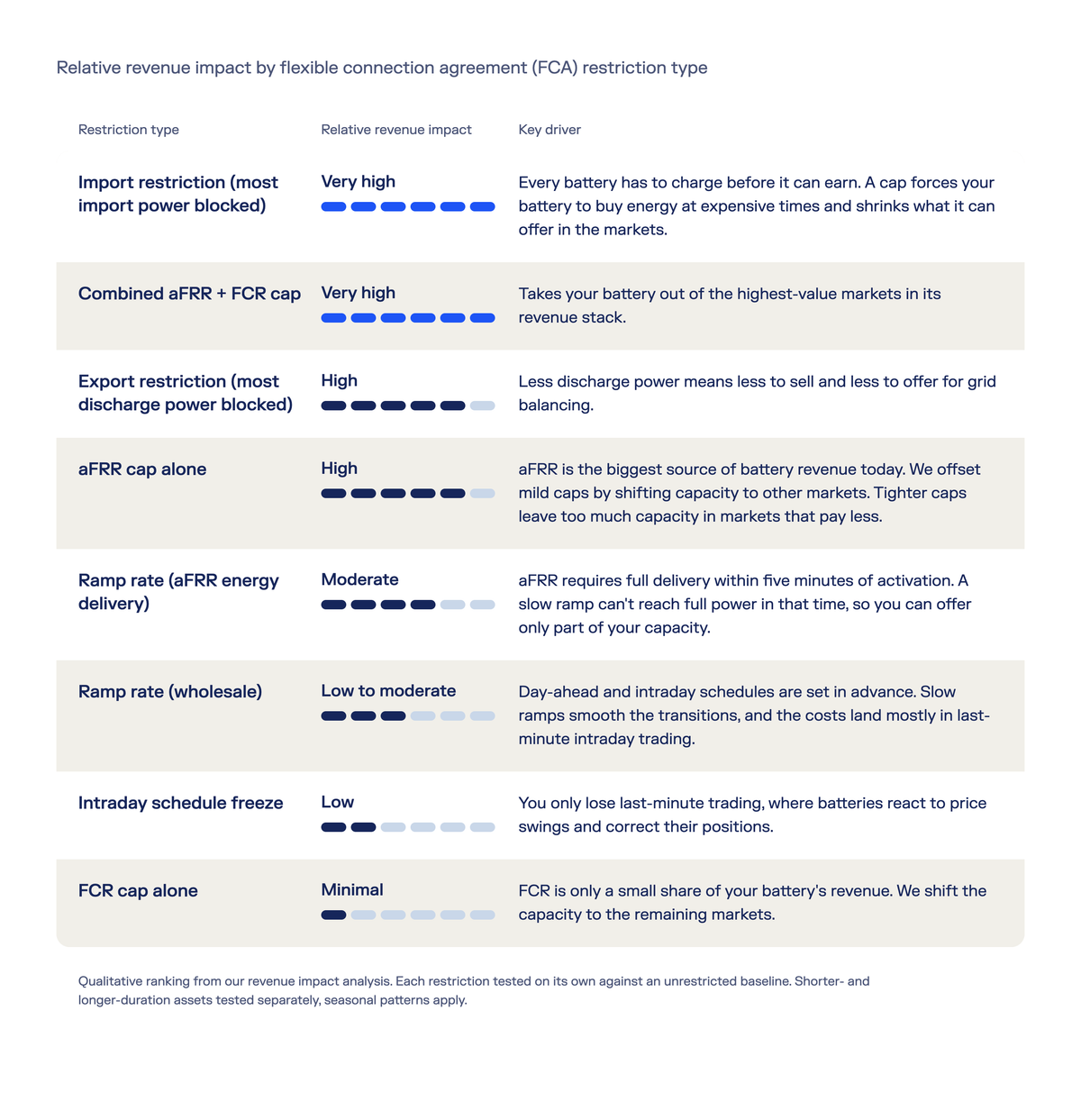
This ranking is the starting point for negotiation. Restrictions in the red band, such as import limits and combined ancillary service caps, remove enough revenue to shift a business case. Restrictions in the lower bands, such as schedule freezes and FCR-only caps, have a low impact in isolation but they rarely come alone and the impact can change a lot.
Key takeaways
- What matters is what is inside the FCA, not whether you sign one. In most cases, an FCA is the only realistic path to connection. The restriction mix decides the outcome.
- "FCA" is a category of contract, not one condition. It can combine import and export restrictions, ramp rate restrictions, ancillary service restrictions, and schedule freezes.
- The revenue impact spans a wide range. It runs from around 1% to over 50% of baseline revenue, depending on restriction type, the strictness of each one of them and battery duration.
- The ranking is the starting point for negotiation. But only the holistic view on all restrictions combined provides the full picture of revenue impact.
Next in the series
Part 2 goes restriction by restriction: how each clause works, which part of the revenue stack it touches, and where it gives you room to negotiate.